.jpg?1779301483)
Growing a Wildflower Garden in the Woods: A Guide for Allegany County and the Southern Tier
By Cristian Acosta, Ag. Educator CCE Allegany County
There is a particular kind of “magic” in the woods in early May, when the canopy is still bare and the forest floor erupts in bloom before the trees ever leaf out. Spring ephemerals race the season, finishing their entire above-ground life cycle in the brief window of sunlight between snowmelt and full leaf-out. If you have a wooded lot in Allegany County or a similar environment, you already own the conditions most flower gardeners spend years trying to replicate. The work is less about imposing a garden on the woods and more about restoring what belonged there in the first place.
This guide walks through how to do this with our climate (USDA Zone 5a, 5b, and 6a), our soils, and our native plant community in mind.
1) Read the Site Before You Buy a Single Plant
Woodland gardening rewards observation. Before ordering anything, spend a full season (or at least a few weeks across early spring and mid-summer) watching how light, water, and soil behave on your place.
Light is the most important variable. Walk your woods at three times: early April before leaf-out, late May when the canopy closes, and mid-July at peak shade.
- A spot that gets six hours of direct April sun and deep shade in July is ideal for spring ephemerals.
- A spot under hemlock that stays dim all year supports a much narrower plant list: mostly ferns, foamflower, and wild ginger.
Moisture matters next. Lowland pockets that stay damp into June suit different plants than dry slopes that shed water fast. In Allegany County, north-facing slopes and bottomlands hold moisture; south-facing slopes and ridgetops dry out by midsummer.
Soil is essential. Depending on where you are, you may have soils with a thin layer of leaf duff over heavier subsoil: clay, glacial till, or fragipan. Native woodland plants evolved with exactly this. The leaf litter you might be tempted to rake away is the engine of the system. Leave it.
If you want to know exactly the values of nutrients and general health of your soil, Cornell Cooperative Extension offers inexpensive soil tests that give pH, organic matter, and nutrient levels. It's worth doing once, just to know what you're working with. If you would like to know more about soil testing, click HERE to read how to take a soil sample.
Plant What Belongs
The single biggest predictor of success in a woodland garden is matching plants to the conditions that already exist, rather than amending your way into a different ecosystem. Below is a working palette of native woodland plants that thrive in our region.
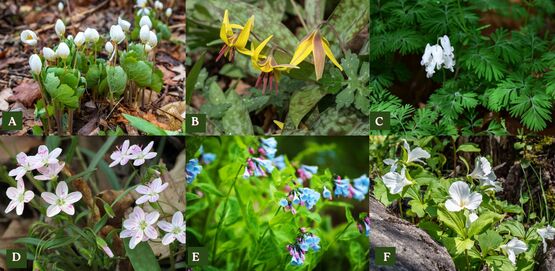
Spring ephemerals (bloom March–May, dormant by July):
- Bloodroot (Sanguinaria canadensis): bright white flowers, blue-green lobed leaves (A)
- Trout lily (Erythronium americanum): mottled leaves, nodding yellow flowers (B)
- Dutchman's breeches (Dicentra cucullaria): delicate, fern-like foliage (C)
- Spring beauty (Claytonia virginica): pink-striped white blooms that carpet the floor (D)
- Virginia bluebells (Mertensia virginica): best in moist, richer pockets (E)
- Trillium (Trillium grandiflorum and T. erectum): slow to establish, worth the wait (F)
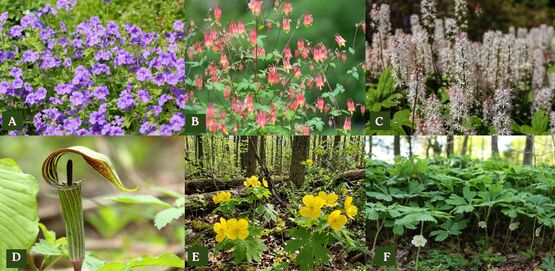
Mid-spring to early summer:
- Wild geranium (Geranium maculatum) (A)
- Wild columbine (Aquilegia canadensis): tolerates more sun and drier soil (B)
- Foamflower (Tiarella cordifolia): excellent groundcover (C)
- Jack-in-the-pulpit (Arisaema triphyllum) (D)
- Wood poppy (Stylophorum diphyllum): long bloom, self-sows readily (E)
- Mayapple (Podophyllum peltatum): forms colonies, dramatic foliage (F)
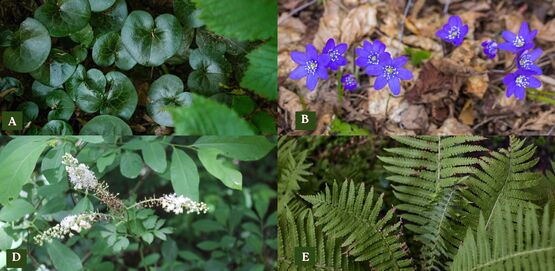
Summer and structural plants:
- Wild ginger (Asarum canadense): heart-shaped leaves, deep shade tolerant (A)
- Hepatica (Anemone americana): among the earliest bloomers (B)
- Black cohosh (Actaea racemosa): tall white flower spikes in July (C)
- Native ferns: Christmas fern (D), ostrich fern, maidenhair, lady fern, sensitive fern
A woodland garden looks best when you plant in drifts rather than singletons and when you let the ephemerals do the heavy lifting in spring while ferns and longer-lived foliage carry the look through summer.
Source Plants Ethically
Never dig wildflowers from the woods, not from public land, not from a friend's property unless that property is being cleared and the plants would otherwise be destroyed (or they give you permission to take the plants). Many of our native woodland species are slow-growing (trillium can take seven years from seed to first bloom), and wild populations are already pressured by deer, invasives, and habitat loss.
Buy from nurseries that propagate their stock. Several New York nurseries specialize in nursery-propagated natives; ask any seller directly whether their plants are nursery-propagated or wild-collected. A reputable native plant nursery will be glad to tell you.
The Finger Lakes Native Plant Society and regional native plant sales (often held by garden clubs and conservation districts in spring) are excellent sources.
Planting and Establishment
In our climate, the best planting windows are early spring (April, as soon as the ground can be worked) and early fall (September into mid-October, giving roots six weeks to settle before a hard freeze).
When you plant, work with the leaf duff rather than removing it. Pull back the litter, dig a hole just big enough for the root ball, set the plant at the depth it grew at the nursery, backfill, water in, and tuck the leaf litter back around the crown. There is no need to amend the hole with potting soil or peat, woodland plants want forest soil, not garden soil.
Water through the first growing season, especially during the dry time we regularly get in July and August. After year one, most woodland natives need no supplemental water in a typical year.
Manage the Real Threats
In Allegany County, what is most likely to defeat your woodland garden are not winter cold or summer heat. They are:
- Deer. Trillium, in particular, is candy to deer. If your woods have deer pressure, you may need fencing, repellents, or a focus on less palatable species like ferns, wild ginger, and bloodroot until populations are well established.
- Invasive plants. Garlic mustard, Japanese stiltgrass, multiflora rose, barberry, and buckthorn will outcompete natives if allowed. Garlic mustard is the most insidious in shaded woods; it releases compounds that suppress the mycorrhizal fungi that native plants depend on. Pull it before it sets seed every spring, for as long as it takes.
- Earthworms. European earthworms present in our forests degrade the leaf duff layer that native wildflowers require. No need to spray or try to control them. There is no easy fix, but maintaining a thick, undisturbed leaf layer helps.
The Long View
A woodland garden is not a short-term project. The first spring after planting will feel modest, maybe a few blooms while plants are finding their footing. By year three, drifts begin to form. By year seven or eight, if you've matched plants to site and kept invasives at bay, the woods will look like they were always meant to look this way. That is the goal, not a garden imposed on the forest.
It is also, quietly, one of the most ecologically valuable things you can do with a piece of land. Native woodland wildflowers support specialist native bees, early-emerging pollinators that depend on these exact species, and a soil community that took hundreds of years to assemble.
If You Experience Issues or Have Questions
Gardening questions are best answered by people who garden in your actual climate, on your actual soils. Cornell Cooperative Extension of Allegany County is an excellent free resource; we are always happy to answer questions about soil testing, plant identification, invasive management, and much more.
Our Master Gardener volunteers are trained specifically for this kind of practical, regional advice and are happy to help.
If you live in a neighboring county or another part of the Northeast, your county's Cooperative Extension office offers the same services. A short phone call or email is often all it takes to get a knowledgeable answer to a question that would otherwise cost you a season of trial and error.
The woods are patient. So is the work. Get the soil right, plant what belongs, pull the invasive weeds, and the spring after next, walk out in early May and see the beautiful results of what you have made.
Contact
Cristian Acosta
Agriculture Educator - Master Gardener Volunteer Coordinator
cfa34@cornell.edu
585-268-7644 ext 14
Last updated May 20, 2026